Esoteric Theravada by Kate Crosby
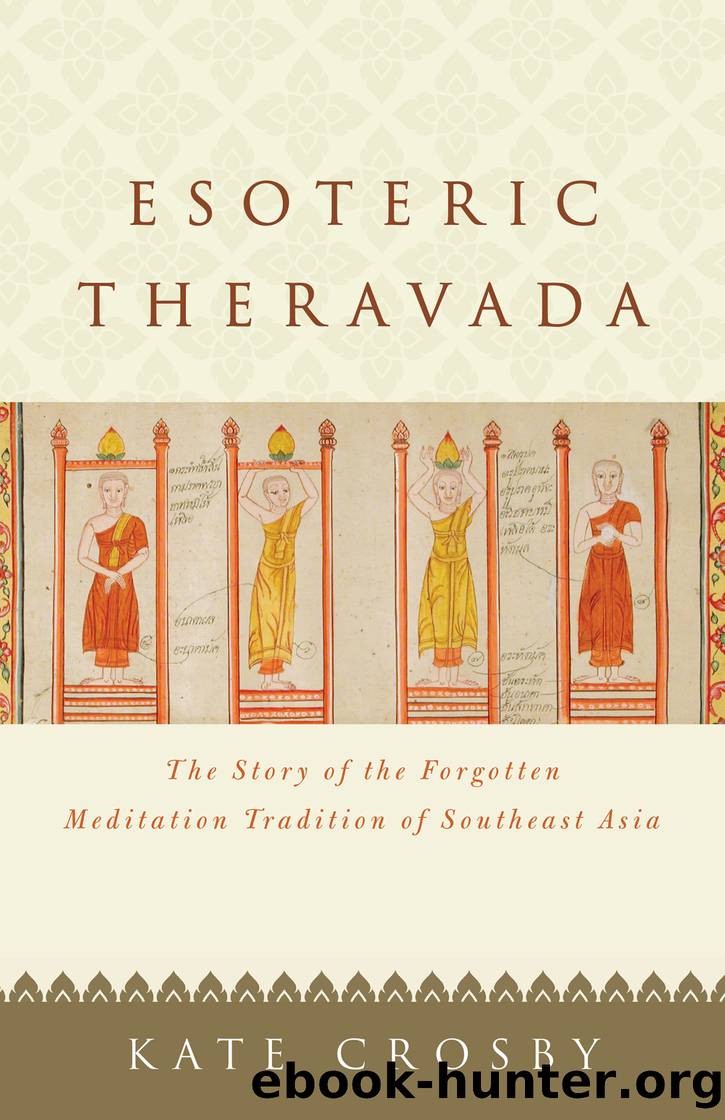
Author:Kate Crosby [Crosby, Kate]
Language: eng
Format: epub
Publisher: Shambhala
Published: 2020-12-22T00:00:00+00:00
The garbha [fetus] is made up of the four elements (prabhava, bhÅ«ta)ânamely, wind, fire, earth, and waterâand six types of nourishment (rasa). These are also constituents of maternal blood, paternal semen, food, and oneâs own deeds, which in turn contribute the components of the garbha. Contributions from karma and the parents thus have a physical basis.23
In the Caraka Saá¹hitÄ the physical components of the body are divided according to whether they come from the mother or the father. There is a general tendency for bloody and softer components such as the flesh, fat, and heart to come from the mother, and harder substances, such as nails, teeth, and bones, to come from the father,24 a division also found throughout borÄn kammaá¹á¹hÄna. The heart is the place where the fetus experiences feelings. Its heart is linked to the motherâs heart. Nutrients pass from the motherâs heart to the fetusâs heart through connecting channels.25
The three doá¹£a/dosa (Sanskrit/Pali) are further associated with three strands or qualities, guá¹a, that make up the material realm: suddha âpure,â rajas âimpulsive,â and tamas âlethargic.â26 The Caraka Saá¹hitÄ understands that the character of the fetus and future child relate to the relative predominance of each of these. It also equates the character of the fetus with different cosmological realms. Fetuses in which the pure (suddha) quality predominates are equated with different deities, and the character of the child-to-be will match the qualities of the relevant gods. The BrahmÄ-god fetus will be truthful and wise, the Indra type powerful, et cetera.27 Buddhism similarly equates different mental states, based on the three roots of akusala (greed, hatred, and delusion) and the three roots of the beautiful mental states (non-greed, non-hatred, and non-delusion), which are present in such meditative attainments as the jhÄna, with different cosmological realms.28 Both traditional medicine and Buddhism therefore correlate the character of an individual with their constitution and with cosmological realms.
Download
This site does not store any files on its server. We only index and link to content provided by other sites. Please contact the content providers to delete copyright contents if any and email us, we'll remove relevant links or contents immediately.
| Africa | Americas |
| Arctic & Antarctica | Asia |
| Australia & Oceania | Europe |
| Middle East | Russia |
| United States | World |
| Ancient Civilizations | Military |
| Historical Study & Educational Resources |
The Dawn of Everything by David Graeber & David Wengrow(1711)
The Bomber Mafia by Malcolm Gladwell(1629)
Facing the Mountain by Daniel James Brown(1557)
Submerged Prehistory by Benjamin Jonathan; & Clive Bonsall & Catriona Pickard & Anders Fischer(1458)
Wandering in Strange Lands by Morgan Jerkins(1432)
Tip Top by Bill James(1418)
Driving While Brown: Sheriff Joe Arpaio Versus the Latino Resistance by Terry Greene Sterling & Jude Joffe-Block(1378)
Red Roulette : An Insider's Story of Wealth, Power, Corruption, and Vengeance in Today's China (9781982156176) by Shum Desmond(1361)
Evil Geniuses: The Unmaking of America: A Recent History by Kurt Andersen(1357)
The Way of Fire and Ice: The Living Tradition of Norse Paganism by Ryan Smith(1341)
American Kompromat by Craig Unger(1321)
F*cking History by The Captain(1308)
It Was All a Lie by Stuart Stevens;(1302)
American Dreams by Unknown(1289)
Treasure Islands: Tax Havens and the Men who Stole the World by Nicholas Shaxson(1275)
Evil Geniuses by Kurt Andersen(1259)
White House Inc. by Dan Alexander(1216)
The First Conspiracy by Brad Meltzer & Josh Mensch(1175)
The Fifteen Biggest Lies about the Economy: And Everything Else the Right Doesn't Want You to Know about Taxes, Jobs, and Corporate America by Joshua Holland(1127)
